By Charlie Devereux and Borja Suarez
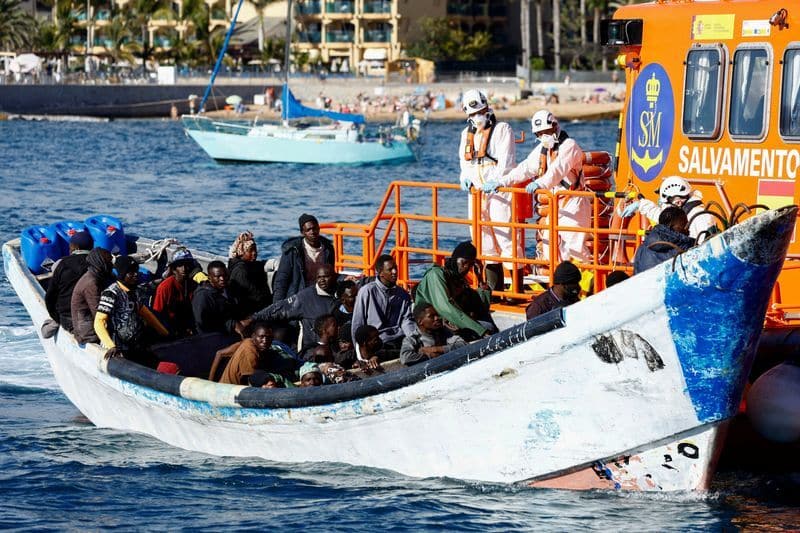
MADRID, Jan 14 (Reuters) - Migrants crossing from West Africa to Spain’s Canaries started using more distant - and potentially more deadly - departure points in 2025 following a crackdown by Mauritania on irregular migration, according to data published by the Red Cross.
The number of small boats arriving in the Canaries from the Gambia, south of Mauritania, more than doubled to 22 in 2025 from nine in 2024, according to the data.
Three boats from Guinea, further south still, also arrived in 2025, with one boat departing from its capital Conakry more than 2,000 kilometres (1,243 miles) from the Spanish archipelago, a journey that took 11 days.
Migrants and human rights groups say that police began clamping down on immigrants in Mauritania in March last year. It followed the signing of a pact with the European Union in 2024 aimed a curbing irregular migration.
Spanish Prime Minister Pedro Sanchez made three visits to Nouakchott in the past two years after arrivals to the Canaries reached a record 46,843 in 2024 and Mauritania became the main point of departure.
The European Commission did not immediately respond to a request for comment.
The Red Cross data - gathered through interviews with arrivals in the Canaries - showed that departures from Mauritania fell by 89% to 23 between April 1 and December 31 last year compared to 216 in the same period of 2024.
Arrivals on the Canaries from West Africa were down 59% in 2025 through to October from a year earlier, Spain’s Interior Ministry says.
“The fact that people are leaving farther south on that route means that they have longer to travel, they need to get farther on supplies, they need money for fuel, all of which means that it’s riskier still. The most lethal crossing to (Europe) is sadly set to become more lethal still,” said Hassan Ould Moctar, a lecturer in the anthropology of migration at SOAS University of London.
(Reporting by Charlie Devereux and Borja Suarez, editing by Aislinn Laing and Alex Richardson)