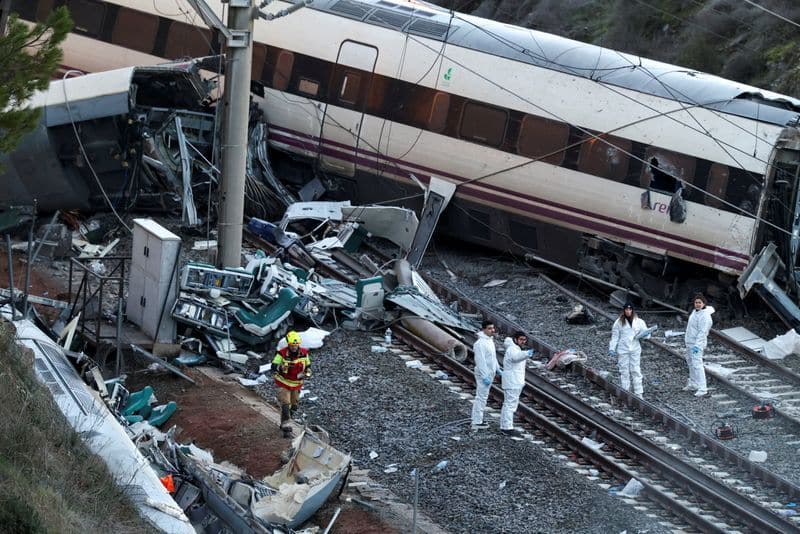
ADAMUZ, Spain, Jan 19 (Reuters) - Experts probing the cause of Sunday’s derailment of a high-speed train in Spain, which killed at least 39 people, found a broken joint on the rails, according to a source briefed on initial investigations into the disaster.
The derailed carriages smashed into an oncoming train, pushing it off the tracks and down an embankment in one of the worst train disasters in Europe in modern times.
The accident happened near Adamuz in the southern province of Cordoba, about 360 km (220 miles) south of the capital Madrid.
Technicians on site analysing the rails identified some wear on the joint between sections of the rail, known as a fishplate, which they said showed the fault had been there for some time, the source said.
They found that the faulty joint created a gap between the rail sections that widened as trains continued to travel on the track.
The source, who declined to be identified due to the sensitivity of the issue, said the technicians believe the faulty joint is key to identifying the precise cause of the accident.
Spain’s Commission of Investigation of Rail Accidents (CIAF), which has been tasked with the overall investigation into the causes of the disaster, did not immediately respond to requests for comment.
The Spanish rail operator, Adif, the Spanish transport ministry - which oversees the CIAF - also did not respond to requests for comment.
Álvaro Fernandez Heredia, president of Renfe, which operates the second train to derail, told the Cadena Ser radio station it was too early to talk about the cause. However, the accident happened in “strange conditions”, he said, adding that “human error is practically ruled out.”
INITIAL FINDINGS FROM THE INSPECTION
The first carriages of the train operated by Spanish firm Iryo drove over the gap in the rails, but the eighth, and last, carriage derailed, bringing with it the seventh and sixth carriages, the person said.
Iryo is a private rail operator, majority-owned by Italian state-controlled railway group Ferrovie dello Stato.
The source pointed to a photograph showing the gap in the vertical rail, which also featured in a handout picture shared with media by Spain’s Guardia Civil. The area has been marked by police incident numbers as it is photographed by forensic inspectors.
Spanish Prime Minister Pedro Sanchez and Transport Minister Oscar Puente were among officials who visited the crash scene on Monday morning. Sanchez cancelled his trip to the World Economic Forum in Davos, Switzerland after the accident.
Puente said that the Iryo train was less than four years old and that the railway track had been completely renovated last May.
The train manufacturer, Hitachi Rail, carried out an inspection of the train on January 15 as part of routine maintenance and found no anomalies, the source told Reuters.
The train is a Frecciarossa 1000, the same model used on Italy’s high-speed network.
(Reporting by Reuters; Editing by Josephine Mason in London and Jon Boyle)