By Bruna Cabral
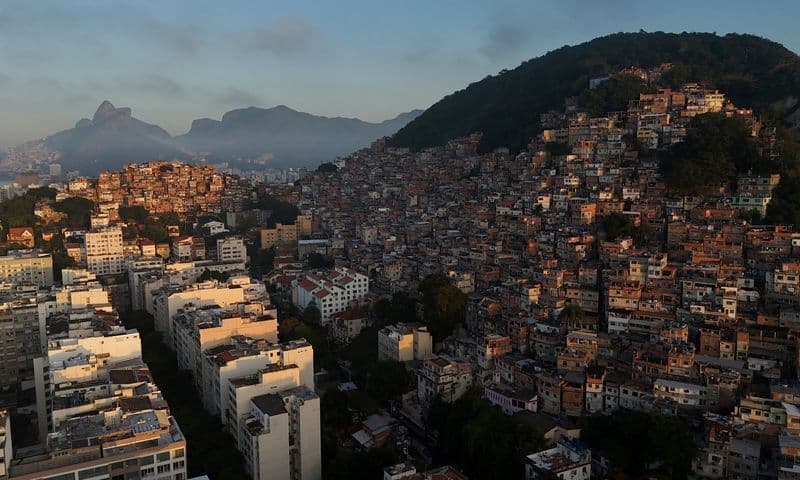
RIO DE JANEIRO, Jan 19 (Reuters) - Michele Campos feels like crying every summer when temperatures in Rio de Janeiro climb above 40°C (100°F), heating up the cement that covers every corner of the favela of Chapeu Mangueira where she lives and making life unbearable in her windowless bedroom.
“Sleeping is the worst part,” said the 39-year-old. “In the favela we experience the heat in a very different way from people who can afford air conditioning.”
Researchers from Utrecht University in the Netherlands, together with local partners, are now trying to understand exactly how extreme heat strains the livelihoods of the 1.3 million people who, like Campos, live in Rio’s favelas, working-class neighbourhoods built by residents without any urban planning.
“We don’t have architects or engineers. We build out of necessity,” said Valdinei Medina, who heads the Percilia and Lucio Renewable Energy Cooperative, Brazil’s first solar energy cooperative based in favelas.
“When the heat comes, we suffer a lot,” he said.
The researchers have installed thermometers in people’s homes in the favelas of Chapeu Mangueira and Morro da Babilonia to measure indoor temperatures and asked residents to keep “heat diaries,” documenting how high temperatures affect their bodies and daily routines.
The goal is to show how climate change affects people unevenly in a city known for its stark inequality, with working‑class homes sprawling across rolling hills above wealthy neighbourhoods.
The data the researchers collect could help inform public policy that takes into account not only heat levels on the streets but also conditions inside homes, said Francesca Pilo, the project’s coordinator and a professor of urban planning at Utrecht University.
The study, she added, is the “starting point for understanding how climate change, often seen as an environmental issue but one that becomes political, has been amplifying urban inequalities that already existed.”
(Reporting by Bruna Cabral in Rio de Janeiro, editing by Manuela Andreoni)