By Anthony Deutsch, Andrew Gray, Lili Bayer and John Irish
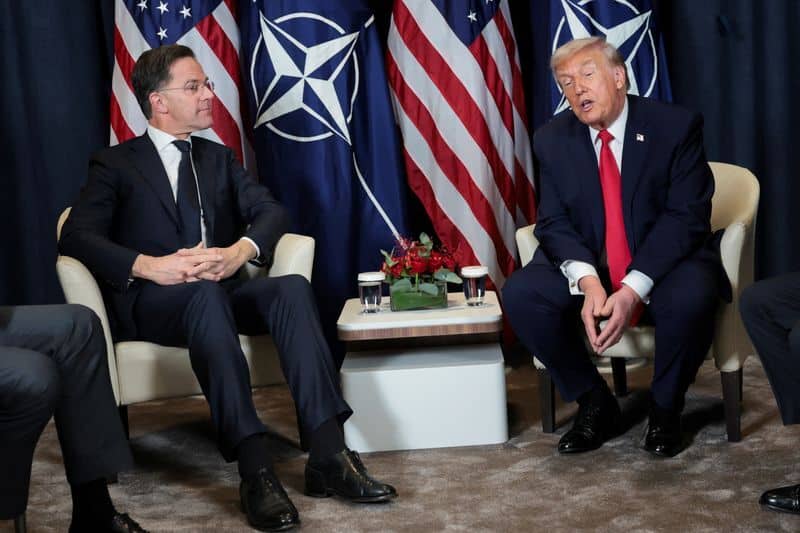
AMSTERDAM/BRUSSELS, Jan 22 (Reuters) - As tensions over Greenland between Donald Trump and Europe neared boiling point this week, NATO boss Mark Rutte cemented his reputation as a “Trump whisperer” after the U.S. president dropped his tariff threats following a meeting in Davos.
Trump said he and Rutte agreed on a “framework of a future deal” on the entire Arctic Region, which would be “a great one for the United States of America, and all NATO Nations”.
While details were scant, the outcome was a diplomatic win for Rutte that steered the fraying transatlantic alliance back from the precipice, diplomats and political analysts said.
Rutte, who served as Dutch prime minister for 14 years, was already known as “the Trump whisperer” in European newspapers when he took up the NATO job a month before Trump’s re-election in 2024, based on their rapport during Trump’s first term.
His strategy is not subtle - it is built on lavishing praise on the U.S. president, even as other European leaders are increasingly critical of Trump.
“The work of the Secretary General of NATO is always important. And when it’s manifested in the personality of Mark Rutte, who’s cool, calm, and collected, and is able to talk with the president of the United States, we should just be thankful that he’s our secretary general right now,” Finnish President Alexander Stubb told Reuters in Davos.
Trump had previously said the U.S. needed to own Greenland. Quite how much of his backtracking was down to Rutte was unclear. He had already taken military force off the table before his meeting with the NATO chief.
But many diplomats give Rutte credit for holding NATO together and managing turbulent transatlantic ties with Trump in the first year of the U.S. president’s second term.
“He is not perfect. Allies may have different opinions about him and his managing style. But he is very good at keeping this alliance together in difficult times,” a European diplomat said.
“President Trump was already prepared for concessions and Rutte was the perfect interlocutor.”
While a frenzy of diplomacy in global capitals laid the groundwork, and Europe’s strong backing for Denmark’s refusal to cede Greenland played a part, Rutte’s personal intervention was seen as crucial.
A senior NATO diplomat said the agreement showed why Rutte “does what he does to stay on speed dial” with Trump.
CALLING TRUMP ‘DADDY’
The latest NATO compromise came on the back of a similar intervention by Rutte in The Hague in June, when he poured on the charm, likening Trump to a “daddy” in global conflicts.
He successfully negotiated a deal that saw allies agree to Trump’s call for an increase in military and related spending to 5% of GDP.
Trump, clearly delighted, brought up the “daddy” comment in his speech on Wednesday in Davos.
Now Rutte has proposed a framework agreement that would see the alliance beef up security for Greenland and the broader Arctic, addressing what Trump says are concerns about threats posed by China and Russia.
While French President Emmanuel Macron called Trump a bully in his own speech at Davos, Rutte has always lauded Trump. In a text that Trump posted on social media this week, Rutte praised his “incredible” work in Syria and commended his work on Gaza and Ukraine.
UNDERSTANDING TRUMP
Rutte, who honed his consensus-building skills keeping together coalition governments in the politically fractious Netherlands, often refuses requests from journalists to discuss sensitive matters on camera. He changes topics, saying diplomatic problems should not be splashed across newspaper headlines.
Tim Sweijs, director of research at The Hague Centre for Strategic Studies, said Rutte’s ability to keep parties together for such a long stint as prime minister made him “a somewhat rare political figure” in the Netherlands.
“Instead of withdrawing — as many leaders do — and limiting discussions to a small inner circle, he would always pick up his old Nokia phone and call both his coalition partners and members of the opposition,” Sweijs said.
That has left Rutte open to criticism that he is willing to set aside ideals to reach an agreement, said Simon Otjes, associate professor of Dutch politics at Leiden University.
“He’s famous for saying, ‘If you want vision, then you should go to an eye doctor.’ He’s the guy who gets to the compromise, who brings people together, who makes people feel valued in order to move further,” Otjes said.
“He really tries to understand not just what Trump needs in terms of policy to move, but also what Trump needs psychologically.”
(Additional reporting by Dave Graham in Davos and Andreas Rinke and Sabine Siebold in BerlinEditing by Peter Graff)