Jan 31 (Reuters) - Shwe Theingi was instantly drawn to Wutt Yee Aung when they met at the start of their second year at Myanmar’s Dagon University in 2019.
The 19-year-old zoology major stood out with her boyish clothes, short hair and a friendly but outspoken personality, Shwe Theingi said. The two young women, who were active in the student union, quickly became friends.
At about the same time and in the same city, Khant Linn Naing was working at a printing press. He was also pursuing a degree in history at a different university and involved with a student union.
All three students were part of the first generation in decades to come of age in a quasi-democratic Myanmar, enjoying newfound freedoms in the commercial capital of Yangon before the February 1, 2021 military coup.
And all three were caught up in a brutal crackdown against the tens of thousands of young people who took to the streets in support of democracy five years ago.
Many of those protesters took up arms against the junta. Others fled or were detained in prison, where some of them died.
At least 74 political prisoners aged between 18 and 35 have died in detention since the coup, according to previously unreported data from the Assistance Association for Political Prisoners, whose information on Myanmar is often cited by United Nations agencies.
The tally was corroborated with the Political Prisoners Network of Myanmar (PPNM), which monitors the country’s prison system. A total of 273 people charged with public incitement and insurrection after the coup have died while incarcerated, according to PPNM.
Reuters interviewed three associates and relatives of detained students and the two prison monitor groups, and reviewed letters sent by inmates and correctional authorities. Together, they provide the fullest account to date of the conditions experienced by Wutt Yee Aung and Khant Linn Naing and the circumstances of their deaths.
The news agency could not independently verify all the accounts, but they echo allegations made by U.N. investigators last year of “systematic torture, killing and other serious abuses during interrogations and in detention facilities operated by the security forces of Myanmar.”
The junta information ministry did not return multiple requests for comment about the allegations of mistreatment.
The military government’s foreign ministry last year denied U.N. reports of torture and abuse, without addressing specifics. “These one-sided and unfounded allegations are persistently advanced based on such unverified data,” it said in October.
LOST GENERATION
Arrests, torture and conscription, as well as displacement within and outside Myanmar, “have disproportionately affected the younger generation,” the U.N. said in a report last year.
An estimated 300,000 to 500,000 young people have fled the country, which has a population of about 51 million, since the coup, according to the U.N. Development Programme.
When the 2021 crackdown began, Shwe Theingi left Yangon. Wutt Yee Aung remained, participating in the anti-junta resistance until she was arrested in September 2021.
After a junta court convicted her on charges that included insurgency and incitement, she was sentenced to seven years in Yangon’s notorious Insein prison.
Through letters and the occasional phone call, she stayed in touch with her family and Shwe Theingi.
“Mother, I hope you are well,” Wutt Yee Aung said in a letter from prison in February 2024. “I have run out of snacks and medicine, so please transfer 200,000 kyat.”
The hand-written plea for around $100 at official exchange rates also contained a list of medicines, including some for treating nerve damage and asthma.
It was during interrogation in the fortnight after her arrest that Wutt Yee Aung sustained head injuries, according to Shwe Theingi and the Dagon University Students’ Union, which also said that she had no health problems prior to her imprisonment.
Her health eventually deteriorated so severely that she was hospitalised inside prison at least once in mid-2025, Shwe Theingi said.
In one undated letter intended for Shwe Theingi, Wutt Yee Aung asked for about $150 for a medical test. “Please don’t tell my mother about this,” she wrote, “I miss everyone.”
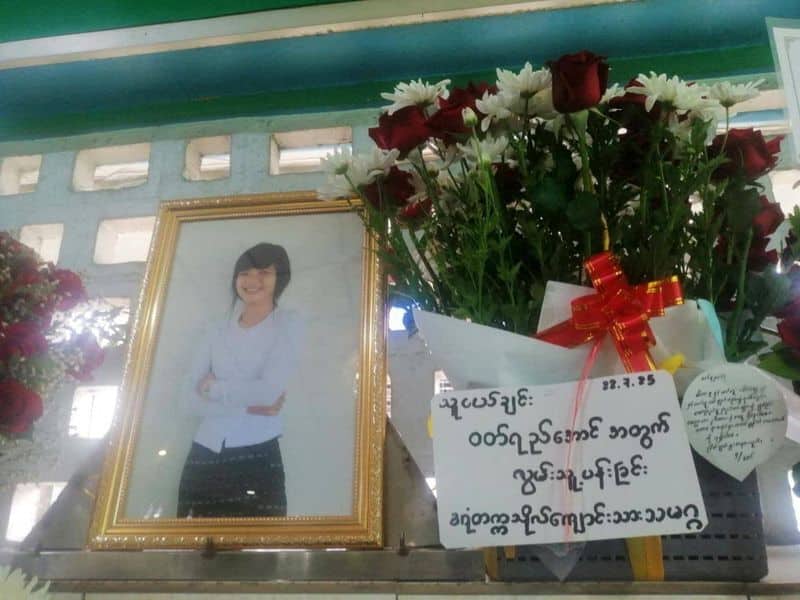
Wutt Yee Aung died in prison on July 19, 2025, at age 25. Authorities told her family that the cause of death was a heart condition, Shwe Theingi said.
The student union challenged the junta version of her death in a statement.
“Due to political prisoners not being given adequate medical treatment, the lack of medicine and restrictions on contact with her family, Ma Wutt Yee Aung died in prison at around 9.30 p.m. on July 19, 2025,” it said, using an honorific for her name.
FATAL TRANSFER
Khant Linn Naing’s family learnt of his arrest on television news.
The 19-year-old was picked up in December 2021 and accused of inciting people to commit offences against the state and insurrection. He was held at Daik-U prison, some 110 km from Yangon, and sentenced by a junta court to 15 years.
In July 2023, his family was jolted again, this time by a letter from correctional authorities, which said Khant Linn Naing had been shot and killed while trying to escape during a prison transfer.
The contents of the letter were described to Reuters by a family member, who spoke on condition of anonymity due to fear of retaliation.
Reuters also viewed a letter sent in June 2023 by prison authorities to the family of another inmate at Daik-U, which said he was killed after “security personnel fired warning shots” when he attempted to escape during a transfer.
A colonial-era rule book that a lawyer and a prison monitor said is still used by correctional authorities allows officials to use weapons like firearms against inmates who are attempting to escape only when “there are no other means available to prevent the prisoner from escaping,” according to a section of the manual reviewed by Reuters.
Neither death notice provided more information about the circumstances of the alleged escape attempts and the junta information ministry did not respond to requests for specific details.
Khant Linn Naing’s parents were not given access to his remains and, over two years after receiving the notice, they have not conducted a funeral, the relative said.
“Because that letter was so unclear, we don’t believe he is dead,” the person said.
PPNM spokesperson Thaik Tun Oo said he found it implausible that Khant Linn Naing had been trying to escape because prisoners are typically restrained and paired with police officials during a transfer.
He added that his organization had been informed by prison sources that Khant Linn Naing had been subject to harsh interrogation shortly before the alleged transfer.
In the years after Wutt Yee Aung and Khant Linn Naing protested the junta, youth uprisings have upended politics and ousted governments elsewhere in Asia, including Bangladesh and Nepal.
Myanmar’s generals, however, have endured. While they have lost territory in their borderlands, the junta has fought back by introducing conscription and expanding aerial power. This month, it concluded a three-phase election that will likely see a military-backed party take power.
“I wanted to become a news presenter. Wutt Yee wanted to do more volunteer work,” Shwe Theingi said. “Each of us had different dreams.”
(Reporting by Reuters Staff, Writing by Devjyot Ghoshal; Editing by Katerina Ang)