By James Pomfret and Jessie Pang
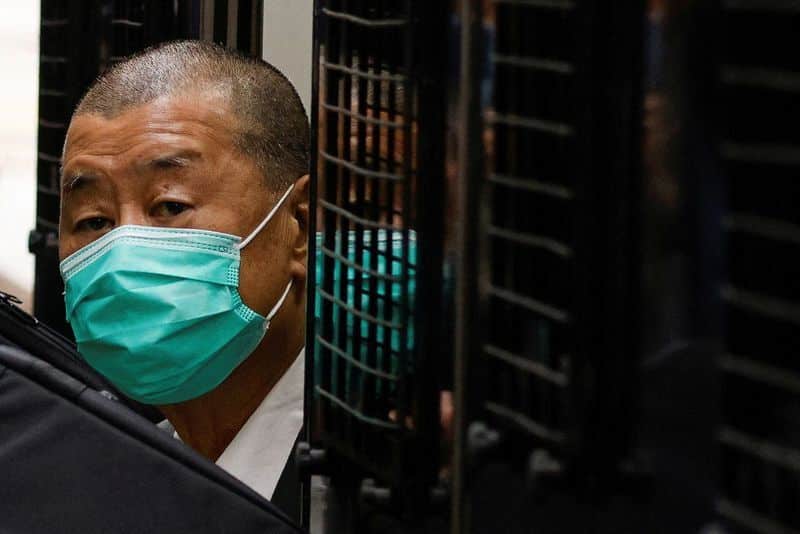
HONG KONG, Feb 9 (Reuters) - Jimmy Lai, the Hong Kong media mogul and China critic, was sentenced on Monday to 20 years in jail, the most severe punishment under the city’s national security law which Beijing imposed after sometimes violent pro-democracy protests in 2019.
The sentence is the latest blow for a self-made millionaire who refused to stay quiet after Beijing’s crackdown that followed Hong Kong’s 2019 protests, continuing to speak out about the risks of authoritarianism at home and abroad.
Known for his stocky boxer-like build, punchy speech and uncompromising nature, Lai used his fortune to bankroll Hong Kong’s pro-democracy movement while his tabloid newspaper, Apple Daily, backed liberal causes and never shied away from criticising authorities until it was shut down in 2021 after police raids.
Those raids came after Beijing imposed a national security law on Hong Kong and arrested Lai soon afterward, charging him with collusion with foreign forces and sedition.
Speaking before his arrest, Lai told Reuters he would “fight on till the last day.”
Lai, 78, has been in custody for more than five years, much of it in solitary confinement, and his health has suffered.
A devout Catholic, Lai had been held in a cell with a small window facing a corridor, according to his family. Those close to him say his faith has helped strengthen his fight in court and against the Chinese Communist Party.
Cardinal Joseph Zen, 94, a prominent pro-democracy advocate and leading Catholic cleric, used to visit Lai in jail.
Lai’s rags-to-riches-to-defiance story is emblematic of Hong Kong - a former British colony returned to Chinese rule in 1997 - that has long prided itself on its grit and enterprise, but whose enthusiasm for Western liberal values ultimately proved too much for Beijing.
EARLY YEARS
A scrappy youth who eked out a living on the streets of Guangzhou in southern China, Lai fled in 1961 to Hong Kong in the hold of a fishing boat. That penniless teenager went on to run his own factory and build the successful clothing chain Giordano.
The June 1989 killings of pro-democracy protesters by People’s Liberation Army tanks and troops in and around Beijing’s Tiananmen Square was a watershed moment, pushing Lai more towards activism and journalism.
He founded a weekly, Next Magazine, in 1990, and after Giordano stores in mainland China were blacklisted in the mid-90s over his activism, Lai sold the business and used the proceeds to launch Apple Daily in 1995.
The feisty tabloid mixed stories about crime with sex scandals, horse racing tips and investigations of Hong Kong and China’s elite, becoming an instant success.
Lai penned a column that called Li Peng, China’s premier at the time who was among a group of officials blamed for the Tiananmen crackdown, the “son of a turtle’s egg”, a highly offensive term. He later called China’s current leader Xi Jinping a “dictator.”
“The more information you have, the more you’re in the know,” Lai said in court. “The more you are free.”
After taking control of Hong Kong in 1997, Beijing promised wide-ranging freedoms and a high degree of autonomy under a “one country, two systems” model of governance. But critics, including Lai, said the ongoing national security crackdown has eroded those pledges.
In 2014, during the “Umbrella Movement” when highways were occupied by protesters for 79 days in a push for full democracy, Lai was among those arrested, although he avoided jail.
But in 2019, when millions demonstrated against China’s tightening grip on Hong Kong, state media called him a “force of evil, not a hero for democracy.”
Lai said at the time: “We have to be flexible and innovative and patient - but persist.”
In delivering Lai’s sentence, the three judges wrote his punishment was enhanced by the fact that he was the “mastermind” and driving force behind the foreign collusion conspiracies.
Chinese and Hong Kong authorities have defended the city’s national security law, saying it has restored stability and that Lai has been given a fair trial.
JUDGE REBUKES LAI FOR SAYING HE’S A ‘POLITICAL PRISONER’
Once listed among Forbes magazine’s 40 wealthiest Hong Kong people with a fortune of HK$1.2 billion ($154 million) in 2008, Lai had his assets and shares in media company Next Digital frozen in 2021, choking off cash flow and leading to its eventual closure.
During his trial, Lai repeatedly referred to himself as a “political prisoner.” This drew a rebuke from one of the judges, who said Lai was in court to face a criminal charge. Lai said he had the right to disagree.
While Lai said his fight for democracy was unlikely to end well for himself, he called the sacrifice an “honour.”
His family, including six children from two marriages, has supported him throughout.
In October, his wife Teresa was photographed with one of the couple’s daughters meeting Pope Leo in St. Peter’s Square in Vatican City wearing formal black attire as concerns grew about Lai’s health.
“Our father was strong going in, mentally he still is, but physically he is significantly weaker now,” the daughter, Claire, told Reuters. Her father suffered from back and waist pains, diabetes, heart palpitations and blood pressure that was “significantly higher” than a year ago, she said.
“Going to court itself and long trials are hard already, but he was grilled and attacked by both the judges and the prosecution,” she added. “All they proved, however, was that my father is a man who loves God, loves truth, loves freedom and loves his family.”
($1 = 7.7815 Hong Kong dollars)
(Reporting by Jessie Pang and James Pomfret; Editing by Anne Marie Roantree and Thomas Derpinghaus)