By Philip Blenkinsop
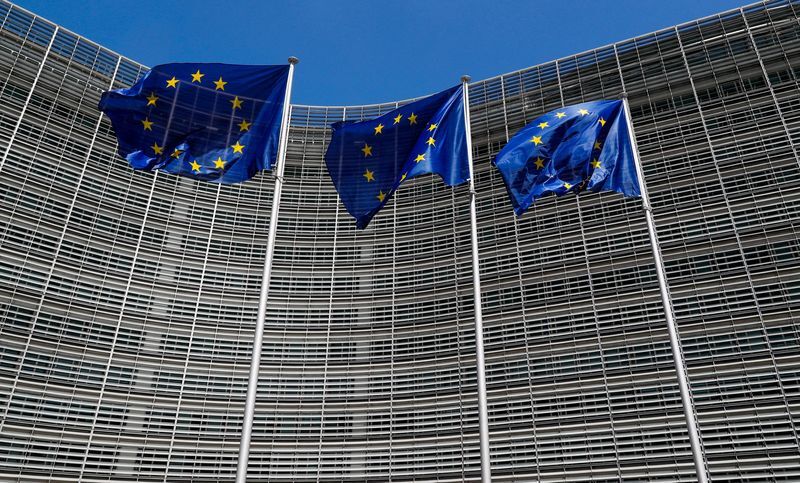
BRUSSELS, Feb 11 (Reuters) - European Union leaders gather in a Belgian castle on Thursday to thrash out how they can compete economically with a global rival like China and a less reliable ally like the U.S. as the rules-based world order frays.
EU growth has been persistently lower than that of the United States over the past two decades, with EU productivity and innovation, particularly in fields like AI, falling short.
The EU is now contending with Donald Trump’s trade war, and most recently tariff threats over Greenland, as well as Chinese restrictions on exports of critical minerals that the 27-nation bloc urgently needs.
With the EU needing greater wealth to cover decarbonisation and digitalisation and strengthen its defence in the face of a belligerent Russia, the bloc is increasingly aware that now is the time for action.
European Council President Antonio Costa, who chairs EU summits, will host leaders for a brain-storming “retreat” at the 16th-century Alden Biesen castle in eastern Belgium to discuss what action to take.
Former Italian prime ministers Mario Draghi and Enrico Letta, authors of two influential reports in 2024 on the EU’s competitiveness challenge and its single market, are also invited to share their views.
But Reinhilde Veugelers, senior fellow at think tank Bruegel, was sceptical whether the brainstorming on Thursday would bring more than just a “nice declaration”.
RESPONSE TO TRUMP, CHINA, RUSSIA
The report of Draghi, who has headed the European Central Bank, has been taken up as a blueprint the EU should follow, with a series of European Commission proposals on financing, defence and reduced regulation since September 2025.
However, the European Policy Innovation Council think tank, whose Draghi Observatory monitors uptake of his 383 recommendations, said that up to January only 15% had been implemented and a further 24% partially implemented. Progress, it said, was more incremental than transformational.
Letta said the glass was “half-full” on deepening the single market, with some progress on critical initiatives like services and capital. He said the EU needed to complete an energy union, a digital union and an EU-wide capital market that could match U.S. investments in newer companies and infrastructure.
His key message to leaders would be to commit to a deadline of completing the EU single market by 2028.
“I think that is the only way to respond to Trump and to external pressures that the European Union is under from China, Russia and the U.S. in different ways,” he told Reuters.
FRENCH-LED MADE-IN-EUROPE PUSH
While all EU countries want a more competitive bloc, they disagree on how to get there.
French President Emmanuel Macron renewed his call on Tuesday for the EU to embark on more common borrowing to invest at scale and challenge the hegemony of the dollar.
France is also pushing a “Made in Europe” strategy that would set minimum requirements for European content in goods bought with public money.
The approach has split EU countries and alarmed automakers, who get many components for cars from outside the EU.
Germany says the key is to boost productivity rather than build new debt. It also stresses the need for trade deals, such as with South American bloc Mercosur, which France rejects due to opposition from French farmers.
Ahead of Thursday’s retreat, German Chancellor Friedrich Merz and some other EU leaders will convene in Antwerp with company chiefs on Wednesday for an industry summit designed to spell out the demands of European business.
“The good thing about European problems is that Europe could actually fix them itself if it wanted to. Because a lot is about flexibility, less bureaucracy, more flexible labour laws,” Siemens Energy CEO Christian Bruch told Reuters.
($1 = 0.8393 euros)
(Reporting by Philip Blenkinsop; additional reporting by Julia Payne, Jan Strupczewski, A Lennon in Brussels, Sarah Marsh and Christoph Steitz in Berlin; editing by Mark Heinrich)