By Jonathan Landay
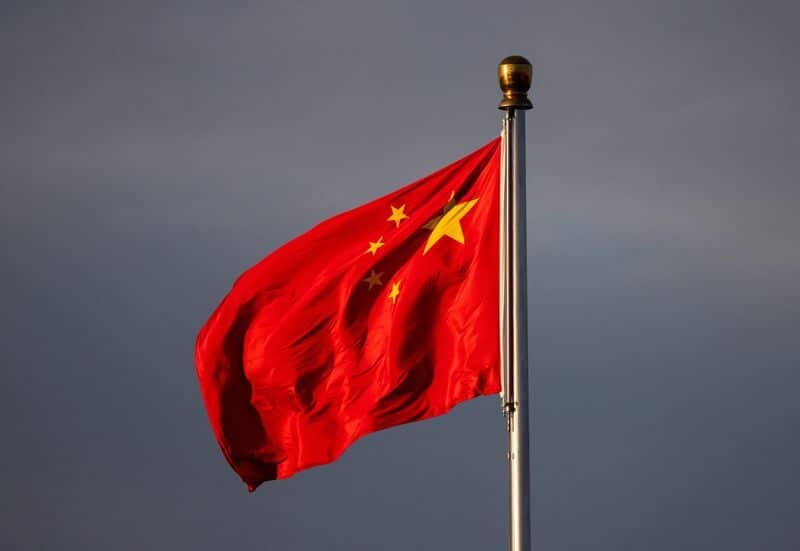
WASHINGTON, Feb 17 (Reuters) - A senior U.S. official on Tuesday revealed what he said were new details of an underground nuclear test blast that China allegedly conducted in June 2020.
Assistant Secretary of State Christopher Yeaw told an event at the Hudson Institute think tank in Washington that a remote seismic station in Kazakhstan measured an “explosion” of magnitude 2.75 located 450 miles (720 km) away at the Lop Nor test grounds in western China on June 22, 2020.
“I’ve looked at additional data since then. There is very little possibility I would say that it is anything but an explosion, a singular explosion,” said Yeaw, adding that the data were not consistent with mining blasts.
“It’s also entirely not consistent with an earthquake,” said Yeaw, a former intelligence analyst and defense official who holds a doctorate in nuclear engineering. “It is … what you would expect with a nuclear explosive test.”
The Comprehensive Test Ban Treaty Organization, which is charged with detecting nuclear test explosions, said that there was insufficient data to confirm Yeaw’s allegation with confidence.
The Chinese embassy in Washington did not immediately respond to a request for comment.
U.S. President Donald Trump is pressing China to join the U.S. and Russia in negotiating a replacement pact to New START, the last U.S.-Russia strategic nuclear arms limitation agreement, which expired on February 5.
The treaty’s expiration has fueled concerns that the world is on the verge of an accelerated nuclear arms race.
CHINA DENIES NUCLEAR TESTING
China, which has signed but not ratified the 1996 international treaty banning nuclear testing, denied setting off an underground nuclear test blast after the U.S. first leveled the allegation at an international conference earlier this month. China’s last official underground test took place in 1996.
The PS23 seismic station in Kazakhstan is part of a globe-spanning monitoring system operated by the Comprehensive Test Ban Treaty Organization (CTBTO).
The organization’s executive secretary, Robert Floyd, said in a statement that the PS23 station recorded “two very small seismic events” spaced 12 seconds apart on June 22, 2020.
The CTBTO’s monitoring system can detect “events” consistent with nuclear test explosions with yields of 551 tons (500 metric tons) of TNT or greater, he said.
“These two events were far below that level. As a result, with this data alone, it is not possible to assess the cause of these events with confidence,” Floyd said.
Yeaw said that China tried to conceal the test by using a method known as decoupling, in which the device is detonated inside a large underground chamber to reduce the magnitude of the shockwaves it sends through the surrounding rock.
Like China, the U.S. has signed but not ratified the test ban. Under international law, both countries are obligated to uphold the pact.
The U.S. conducted its last underground nuclear test in 1992 and has been relying on a multibillion-dollar program that uses advanced tools and supercomputer simulations to ensure its nuclear warheads work properly.
China has rejected Trump’s call to negotiate a three-way treaty to replace New START, contending that its strategic nuclear arsenal is dwarfed by those of Washington and Moscow, the world’s largest nuclear powers.
The Pentagon says China now has more than 600 operational warheads and is conducting a major expansion of its strategic nuclear force. It projects that China will field more than 1,000 warheads by 2030.
(Reporting by Jonathan Landay; Editing by Don Durfee and Jonathan Oatis)