By Jayla Whitfield-Anderson, David Shepardson and Andy Sullivan
NEW YORK/ATLANTA/WASHINGTON, March 23 (Reuters) - The strained U.S. air-travel system was stretched even further on Monday after two pilots died in a runway accident that shut New York’s LaGuardia Airport and President Donald Trump deployed armed immigration agents to help with hours-long lines that have cropped up at security checkpoints nationwide.
The crash between an Air Canada Express jet and a fire truck at LaGuardia injured dozens of passengers and led to hundreds of flight cancellations at the start of the working week, the latest disruption for airports and carriers already contending with a weeks-long budget standoff in Congress and surging fuel costs.
Travelers have endured hours-long waits at security screening checkpoints in recent days as absentee rates have spiked among Transportation Security Administration employees who have gone without pay for more than a month. Hundreds of people were lined up on Monday at some of the nation’s busiest airports, including Los Angeles and Atlanta.
“If the leadership was right we wouldn’t have circumstances like this,” Atlanta resident John Edwards told Reuters as he waited at the city’s airport, where 42% of TSA agents were absent on Sunday.
ICE DEPLOYED TO AIRPORTS
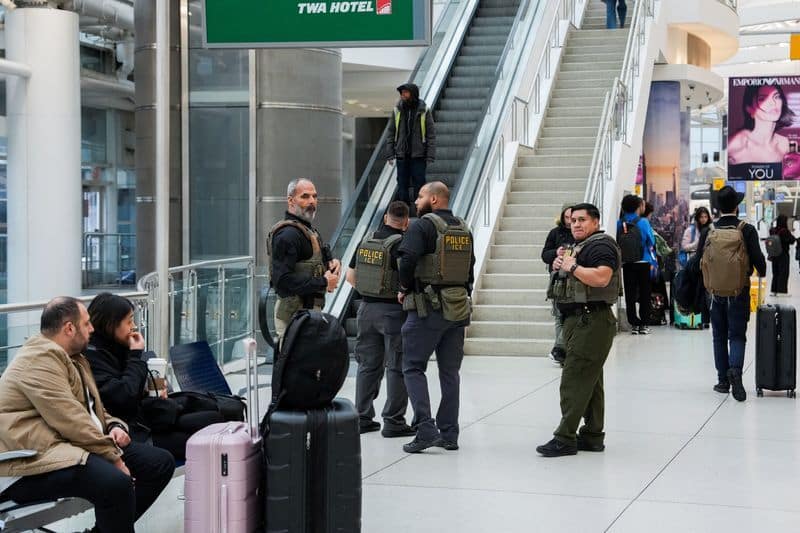
On Monday morning, U.S. Immigration and Customs Enforcement agents wearing flak jackets and pistols stood guard in airports in Atlanta, New York and New Jersey, according to Reuters witnesses. They were not wearing masks, which they had done regularly while carrying out Trump’s immigration crackdown in major cities.
Authorities said the agents would provide crowd control, but Trump said they would also make arrests - raising concerns that the chaotic raids that have played out on the streets of Minneapolis, Chicago and elsewhere might come to the nation’s airports as well.
“They’re able to now arrest illegals as they come into the country. That’s very fertile territory,” Trump told reporters.
In Washington, there was little sign that the standoff between Trump’s Republicans and opposition Democrats would end soon. Democrats have refused to fund the Department of Homeland Security without new curbs on immigration agents, who have killed U.S. citizens and sparked public outrage during their crackdown. Though the White House has engaged in talks, Trump said Monday he would not sign off on any compromise until Congress first passed a series of voting restrictions that Democrats have rejected, adding another potential roadblock to a deal.
Airlines are also facing rising fuel costs, which have spiked since the U.S. and Israel attacked Iran more than three weeks ago. United Airlines said Friday it would cut flights through the busy summer travel season, citing elevated oil prices.
A separate 35-minute ground stop at nearby Newark Liberty International Airport on Monday morning added to delays after air-traffic controllers evacuated their tower because of a burning smell from an elevator, the Federal Aviation Administration said.
LAGUARDIA COLLISION KILLS TWO, SEVERAL HOSPITALIZED
In New York, the pilot and first officer of an Air Canada Express jet were killed when the plane collided with a fire truck while it was landing, while another nine people were hospitalized with serious injuries. The CRJ-900 plane, operated by regional partner Jazz Aviation, had been carrying 72 passengers and four crew members. Some 572 flights were cancelled, more than 50% of LaGuardia’s daily total.
U.S. aviation has faced a chronic shortage of air traffic controllers, but it was not immediately clear what led to the crash, and Transportation Secretary Sean Duffy and other officials were traveling to New York to investigate. Air-crash investigations typically find that accidents result from multiple contributing factors, rather than a single cause.
Kathryn Garcia, executive director of the Port Authority of New York and New Jersey, said the fire truck was responding to a separate aircraft that had reported an “issue with odor.”
According to air traffic control audio, a controller can be heard telling the craft that a fire truck was en route and clearing a truck to cross a runway. Moments later, the controller can be heard saying: “Stop, stop, stop, truck 1 stop, truck 1, stop.”
On Monday morning, the Air Canada jet could be seen on the runway, surrounded by emergency vehicles, its crushed cockpit pointing skyward.
(Reporting by Shannon Stapleton in New York, Jayla Whitfield-Anderson in Atlanta, David Shepardson in Washington and Allison Lampert in Montreal, additional reporting by and Bhargav Acharya; Writing by Andy Sullivan; editing by Scott Malone and David Gaffen)