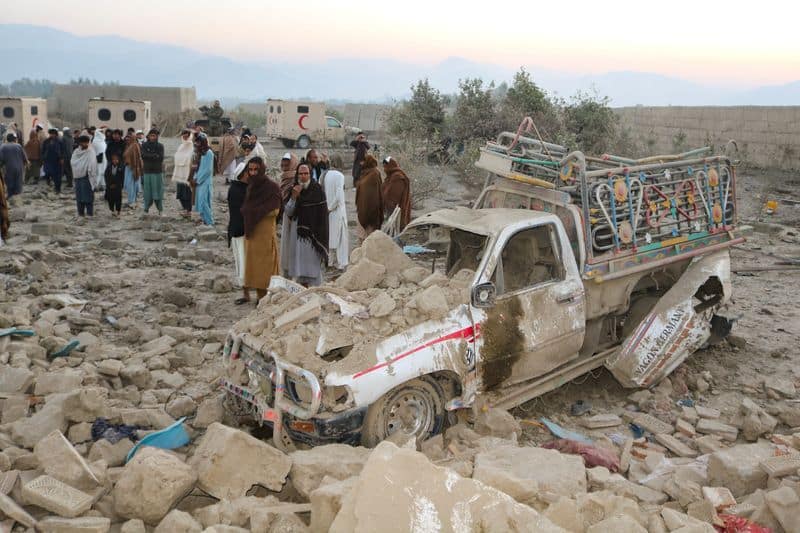
ISLAMABAD, Feb 24 (Reuters) - Tensions have heated up again between Islamabad and Kabul this week after Pakistan launched airstrikes on militant targets in Afghanistan.
Pakistani security sources said the strike killed at least 70 terrorists, while the United Nations said at least 13 civilians were killed.
The attack threatens a fragile ceasefire following border clashes in October that killed dozens of soldiers, the worst fighting between the two countries since the Taliban took over Kabul in 2021.
WHY ARE THE NEIGHBOURS AT ODDS?
Pakistan welcomed the return to power of the Taliban in 2021, with then-Prime Minister Imran Khan saying that Afghans had “broken the shackles of slavery”.
But Islamabad soon found that the Taliban were not as cooperative as it had hoped.
Islamabad says that the leadership of militant group Tehreek-e-Taliban Pakistan (TTP) and many of its fighters are based in Afghanistan, and that secular armed insurgents seeking independence for the southwestern province of Balochistan also use Afghanistan as a safe haven.
Militancy has increased every year since 2022 with attacks from the TTP and Baloch insurgents growing, according to Armed Conflict Location & Event Data, a global monitoring organization.
Kabul for its part has repeatedly denied allowing militants to use Afghan territory to launch attacks in Pakistan.
Even as the fragile ceasefire has held there have been repeated clashes and border closures that have disrupted trade and movement along the rugged frontier.
WHAT SPARKED SATURDAY’S OFFENSIVE?
The day before the strikes, Pakistani security sources said they had “irrefutable evidence” that militants were using Afghan soil to attack Pakistan.
The sources listed seven planned or successful attacks by militants since late 2024 that they said were connected to Afghanistan.
One attack last week that killed 11 security personnel and two civilians in Bajaur district was undertaken by an Afghan national, according to Pakistani security sources. This attack was claimed by the TTP.
WHO ARE THE PAKISTANI TALIBAN?
The TTP was formed in 2007 by several jihadist outfits active in northwest Pakistan. It is commonly known as the Pakistani Taliban.
The TTP has attacked markets, mosques, airports, military bases, police stations and also gained territory - mostly along the border with Afghanistan, but also deep inside Pakistan, including the Swat Valley, where they later shot schoolgirl Malala Yousafzai.
They also fought alongside the Afghan Taliban in Afghanistan and hosted Afghan fighters in Pakistan. Pakistan has launched military operations against the TTP on its own soil with limited success, although an offensive that ended in 2016 drastically reduced attacks till a few years ago.
WHAT HAPPENS NEXT?
After the attack, the Taliban warned “an appropriate and measured response will be taken at a suitable time.”
Analysts say this is likely to come in the way of cross-border action. Two attacks targeted security forces in northwest Pakistan in the days after Pakistan’s airstrikes.
On paper, there is a wide mismatch between the two sides. At 172,000, the Taliban have less than a third of Pakistan’s personnel.
Though the Taliban do possess at least six aircraft and 23 helicopters, their condition is unknown and they have no fighter jets or effective air force.
Pakistan’s armed forces include more than 600,000 active personnel, have more than 6,000 armoured fighting vehicles and more than 400 combat aircraft, according to 2025 data from the International Institute for Strategic Studies. The country is also nuclear armed.
(Reporting by Lucy Craymer in Islamabad and Saad Sayeed in Bangkok; Editing by Aidan Lewis)