By Doina Chiacu
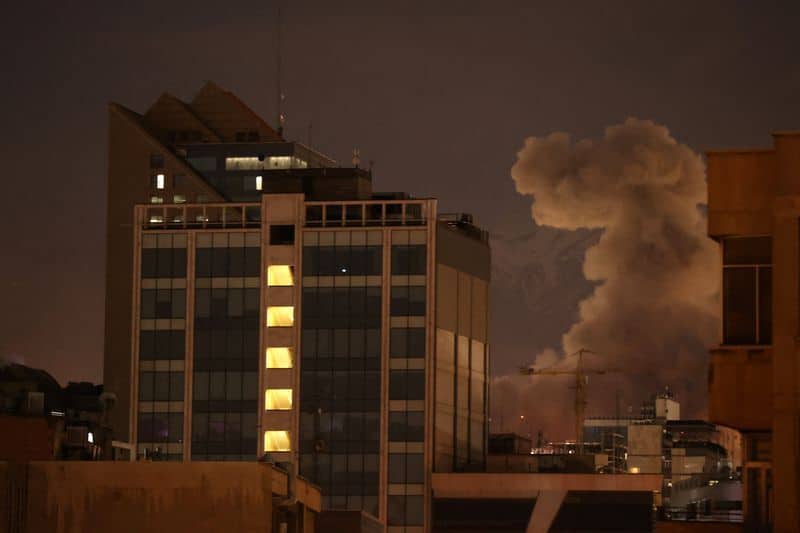
March 1 (Reuters) - The United States has yet to spell out a “day-after” strategy for Iran following joint U.S.-Israeli strikes that killed much of the country’s leadership, lawmakers from both major political parties said on Sunday.
U.S. President Donald Trump has called for a change in Iran’s government, which has entered a period of uncertainty following the death of Supreme Leader Ayatollah Ali Khamenei in Saturday’s attack. The strategy Trump has publicly outlined so far hinges largely on the hope that the Iranian people will rise up and determine their own future after decades of repression.
Republicans expressed optimism about the attacks, while Democrats were skeptical they would lead to a favorable outcome, but lawmakers on both sides were uncertain about the immediate future.
WHAT COMES NEXT?
Lawmakers appearing on Sunday morning talk shows all opposed deploying U.S. ground forces to Iran.
“There’s no simple answer for what’s going to come next,” Senator Tom Cotton, the Republican chairman of the Senate Intelligence Committee from Arkansas, said on CBS News’ “Face the Nation.”
Republican Senator Lindsey Graham of South Carolina, a staunch Trump ally and defense hawk, echoed the U.S. president’s call for Iranian people to decide who should lead their government.
“You know, this idea, ‘You break it, you own it,’ I don’t buy that one bit,” Graham said on NBC’s “Meet the Press” program. “This is not Iraq. This is not Germany. This is not Japan. We’re going to free the people up from a terrorist regime.”
Khamenei’s death set off a process under which a three-person council will run the country until a separate clerical body selects a new supreme leader.
Asked if the U.S. had identified a leader of the Iranian opposition who Iran’s people could rally behind, Cotton said, “The opposition is 90 million Iranians who have suffered under the brutal Islamic Republic Revolutionary regime for the last 47 years.”
Senator Chris Coons, a Delaware Democrat, said he could not see how regime change in Iran could happen with the current operation.
“There’s no example I know of in modern history where regime change has happened solely through air strikes,” Coons said on CNN’s “State of the Union” program.
Before Saturday’s air strikes, the U.S. Central Intelligence Agency assessed that hardline figures from the Islamic Revolutionary Guard Corps could replace Khamenei if he were killed, two sources briefed on the intelligence said.
Trump on Sunday said that a total of 48 leading figures in Iran’s government have been killed so far. Senator Chris Murphy, a Connecticut Democrat, pointed to the earlier CIA assessment.
“So, we are not going to get a democracy. We are going to get an even worse Iranian leadership,” Murphy told the CBS program. “It’s no secret that this administration has no plan for the chaos that is unfolding right now in the Middle East.”
‘WAR OF CHOICE’
The U.S. and Israeli strikes, as well as Iranian retaliation, have sent shockwaves through multiple sectors, such as shipping, air travel and oil, amid warnings of rising energy costs and disruption to business in the Strait of Hormuz, a strategic waterway.
Three U.S. service members have been killed and another five were seriously wounded, in the first U.S. casualties of the unfolding operations against Iran, the U.S. military said on Sunday.
Trump justified the attack in part by pointing to the threat of an Iranian nuclear program that he had until recently claimed had been “obliterated” by U.S. air strikes last June.
While Trump’s fellow Republicans largely fell in line behind the president, several Democratic lawmakers said the attack was illegal because only Congress has the right to declare war under the Constitution.
Senator Mark Warner, the Democratic vice chairman of the Senate Intelligence Committee from Virginia, who was among the eight lawmakers briefed last week before the strikes, said the administration did not provide evidence of an imminent threat. Instead, Warner said, Trump started a “war of choice.”
“I saw no intelligence that Iran was on the verge of launching any kind of pre-emptive strike against the United States,” Warner said on CNN’s “State of the Union.”
Warner and U.S. Representative Ro Khanna, a California Democrat, expressed concern that it could drag the United States into another long and messy conflict in the Middle East.
Khanna, who is helping lead an attempt in the House of Representatives to block further military action without congressional approval, said it was unclear how Iran would be governed following Khamenei’s death.
“Khamenei was a brutal dictator, but Americans are not safer today,” Khanna said. “The question is, ‘is the country going to descend in civil war? Are billions of our dollars going to be spent there? Are American troops going to be at risk’?”
Lawmakers said they wanted to avoid a prolonged and costly conflict reminiscent of the Iraq War, which dragged on for years and claimed thousands of U.S. lives.
Senator Tim Scott, a Republican from South Carolina, said he hopes U.S. involvement in Iran can be completed within a month.
“It all depends on… whoever the new leader is in Iran,” Scott told Fox’s “Sunday Morning Futures” show. “We’re going to finish this, and if we don’t, we’ll be doing this in five years, in 10 years.”
(Reporting by P.J. Huffstutter in Chicago, Doina Chiacu in Washington, Nathan Layne in Wilton, Connecticut and Doyinsola Oladipo in New York; Editing by Sergio Non and Bill Berkrot)