By Tom Balmforth and Max Hunder
LONDON/KYIV, March 30 (Reuters) - Ukraine’s war has forced the country to become a trailblazer in drone interception. The conflict in the Middle East could be its make-or-break moment to take the technology global.
In an effort to export Ukrainian systems and know-how, President Volodymyr Zelenskiy has criss-crossed the Gulf region this weekend to hash out deals with countries that have been targeted by waves of Iranian drone attacks this month.
“Ukraine is sharing expertise that is not available in the Middle East,” Zelenskiy told Reuters in an interview last week. “Expertise is not a drone, but a skill, a strategy, a system where a drone is one part of the defense.”
Indeed, Ukraine has signed framework cooperation deals with Saudi Arabia and Qatar in recent days, and has said one is in the works with the United Arab Emirates. Zelenskiy has stressed that arms sales must be decided at the government level, warning businesses against engaging with clients directly.
Ukraine’s drone sector is chomping at the bit.
“Everybody is sitting and waiting,” said Oleg Rogynskyy, CEO of UForce, a UK-headquartered Ukrainian military tech company which says its Magura sea drone has been the subject of intense commercial interest from the Middle East.
Several industry figures said the U.S.-Israeli war with Iran had underlined the potency of attack drones in modern warfare and exposed many countries’ vulnerabilities to their threat.
The conflict, some added, presented Ukraine with a unique opportunity to jumpstart exports and create a world-leading industry that could provide the backbone for post-war reconstruction and prosperity.
Wild Hornets and SkyFall, two other top Ukrainian interceptor drone makers, said they too had received inquiries from Middle Eastern countries but like UForce were not directly negotiating contracts before getting a green light from Kyiv.
Anastasiia Mishkina, executive director at Tech Force in UA, an association of nearly 100 Ukrainian defence companies, said some members had asked the government for permission to export and were waiting for a response.
“There is a risk of losing the moment because the international market does not wait,” she said.
The government did not immediately respond to a request for comment on whether it risked moving too slowly on defence cooperation at a time of opportunity.
SEA DRONES MOUNTED WITH INTERCEPTORS
Ukraine has developed its technology and expertise over years of countering Russia’s drone attacks - a threat that Gulf states now face from Iran’s relatively cheap Shahed drones.
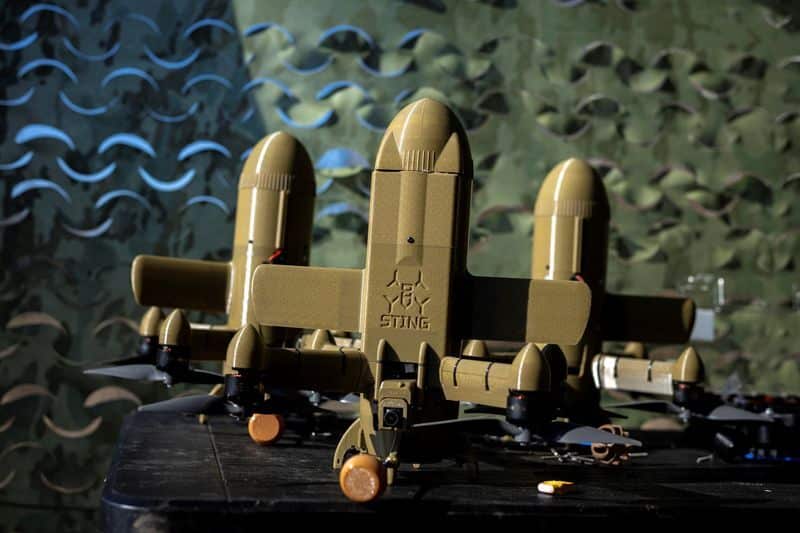
Hundreds of Russian drones are often fired at Ukraine in a single night, spurring an innovation race with the military and private firms developing interceptor drones to bring enemy craft down before they hit their targets.
These interceptors cost a few thousand dollars each, although they do not always succeed and Russia is constantly coming up with ways to get past them.
Ihor Fedirko, CEO of the Ukrainian Council of Defence Industry, a manufacturers’ association, estimated that Ukraine could export about $2 billion worth of weapons as a whole this year, excluding joint production ventures with allies.
He predicted that in a best-case scenario, annual defence exports could reach as much as $10 billion in five years.
Ukraine produced 40,000 interceptor drones in January, according to the government, which has made it clear the country will not export any weapons it needs to defend itself. Zelenskiy says that provided enough financing, Ukraine has the capacity to up its production to 2,000 interceptor drones a day and would only need 1,000 for itself, leaving plenty for export.
Rogynskyy, the UForce CEO, said the Magura sea drone produced by his company had obvious allure in the Gulf.
Ukraine initially used sea drones to attack and harry Russian warships in the Black Sea as an asymmetrical weapon to take on the dominant naval force. They have since become more sophisticated, with Rogynskyy saying they could be mounted with interceptor drones to combat aerial drones over water.
Ukraine’s military, he added, was already using the Magura off its southern coast to intercept Russian drones that pour into the port city of Odesa from across the Black Sea at night.
“It’s fully live, it’s tested,” he said.
Rogynskyy said stations equipped with Maguras carrying interceptors could be sited along the Gulf’s shoreline, operating on software that reduced the need for many personnel.
‘BETTER TO LEARN LATE THAN TOO LATE’
Zelenskiy has previously berated an unnamed Ukrainian-American company for selling interceptor drones without the government’s involvement.
That, he said, had ultimately tainted Ukraine’s reputation because the soldiers needed to train the clients to use the drones had not been available as that could only happen with government backing.
Halyna Yanchenko, a lawmaker close to Ukrainian defence manufacturers, told Reuters the government had moved very slowly to open up weapons exports, and manufacturers were still in dire need of capital to grow their operations.
She said state policy governing how weapons exports would function was still being formed. Like Mishkina at Tech Force in UA, she believed there was a major risk that Ukraine could miss the moment provided by the Iran war if it did not move quickly.
Even if agreements are struck, officials and drone operators said it could take months to set up drone-based air defences and provide training.
Taras Tymochko, head of the interceptor drone program at Come Back Alive, a charitable foundation that has bought tens of thousands of interceptor drones for Ukraine’s military, said the sophisticated systems required a range of specialisms, from pilot training, combat experience and the know-how to safely arming warheads and fix technical malfunctions.
More important still, he said, was installing, configuring and correctly positioning radars to detect and track incoming drones and then to coordinate that work across different units.
He predicted the learning curve would be quicker for the Gulf states than for Ukraine, which had to forge ahead on its own while fighting for its survival.
“I’m confident that within a few months, some Gulf countries could form their own interceptor units and, a little later, begin demonstrating results,” Tymochko said.
“Unfortunately, in today’s reality, that time does not exist. But it is better to learn late than too late.”
(Additional reporting by Dan Flynn, Olena Harmash and Yuliia Dysa in Kyiv; Editing by Mike Collett-White and Pravin Char)