By Stine Jacobsen, Canan Sevgili and Vera Dvorakova
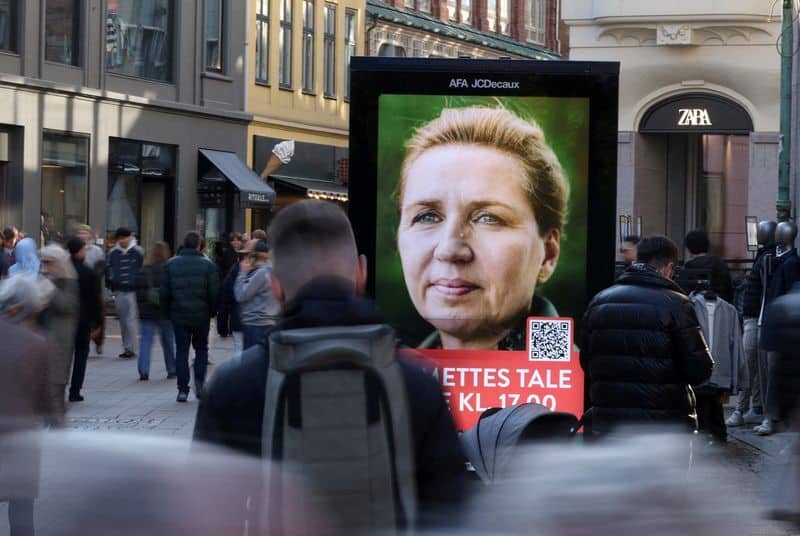
COPENHAGEN, March 23 (Reuters) - Denmark holds an election on Tuesday, with opinion polls showing a narrow lead for Prime Minister Mette Frederiksen’s centre-left bloc, boosted by her defiant stand against U.S. President Donald Trump’s push to take control of Greenland.
But while right-wing parties are trailing, the polls show that the decision on who governs Denmark could ultimately be decided by the centrist Moderates party or even a handful of representatives from Greenland and the Faroe Islands.
WHAT IS AT STAKE IN DENMARK’S ELECTION?
Social Democratic party leader Frederiksen, in power since 2019, is seeking a third consecutive term in office, which could make her Denmark’s longest serving prime minister since World War Two.
The election will show whether Danes reward Frederiksen for her opposition to Trump’s pressure to acquire Greenland or punish her for what some critics call neglect of domestic issues.
Her current bipartisan government faces a near-certain loss of its majority, with polls suggesting a return to traditional left-right political divisions.
Meanwhile, votes from Greenland could provide insight into the semi-autonomous territory’s sentiment on how to pursue independence.
WHAT ARE THE MAIN ISSUES?
The economy is at the top of voters’ minds, a March 12-13 TV2 poll showed, with the environment coming second, foreign and security policy third and healthcare fourth, followed by immigration in fifth place.
The most heated debate of the campaign was over Frederiksen’s proposal to impose a wealth tax on the 20,000 richest people in a nation of 6 million, with proceeds earmarked for better schools and some tax relief.
The proposed 0.5% levy on fortunes above 25 million Danish crowns ($3.87 million) triggered a debate about equality and wealth that could help Frederiksen emerge as leader of a new left-leaning alliance.
On the environment, divisions emerged over the extensive Danish agricultural industry’s use of pesticides and fertilisers, which in turn affects the access to clean water.
While some parties, including the Social Democrats and the Conservatives, are pushing for a nationwide ban on pesticide spraying in vulnerable drinking water areas, others such as the centre-right Liberal Party argued for a more gradual transition.
HOW DOES DENMARK’S ELECTION SYSTEM WORK?
The Kingdom of Denmark elects 179 members to the Folketing: 175 from Denmark, 2 from Greenland, and 2 from the Faroe Islands. Seats are allocated by a proportional representation system to any party that receives at least 2% of the votes.
Danish citizens, including those in Greenland and the Faroe Islands, can cast ballots from the age of 18, with more than 80% of eligible voters typically doing so, either by mail or in person.
WHEN DO THE POLLS CLOSE IN THE DANISH ELECTION?
Voting ends at 8 p.m. (1900 GMT), followed shortly after by exit polls from major news outlets.
Ballots are counted in the hours that follow, with results likely to emerge late on Tuesday evening or in the early hours of Wednesday.
If the outcome is close, a final result may only come during daytime on Wednesday when all ballots have been accounted for.
HOW IS THE DANISH PRIME MINISTER CHOSEN?
When seats have been allocated, the selection of a prime minister begins through the so-called “King’s Round”, where each political party advises the head of state, King Frederik, on their preferred candidate to lead the government.
Based on this, the monarch appoints an individual to form a government or to lead negotiations toward selecting a prime minister. Once the prime minister and ministers are agreed, the king formally appoints the government.
Denmark often forms minority cabinets, where the ruling party or parties lack a parliamentary majority of 90 or more seats, requiring them to secure backing from opposition parties.
($1 = 6.4542 Danish crowns)
(Reporting by Stine Jacobsen in Copenhagen, Vera Dvorakova and Canan Sevgili in Gdansk; Editing by Terje Solsvik and Alison Williams)