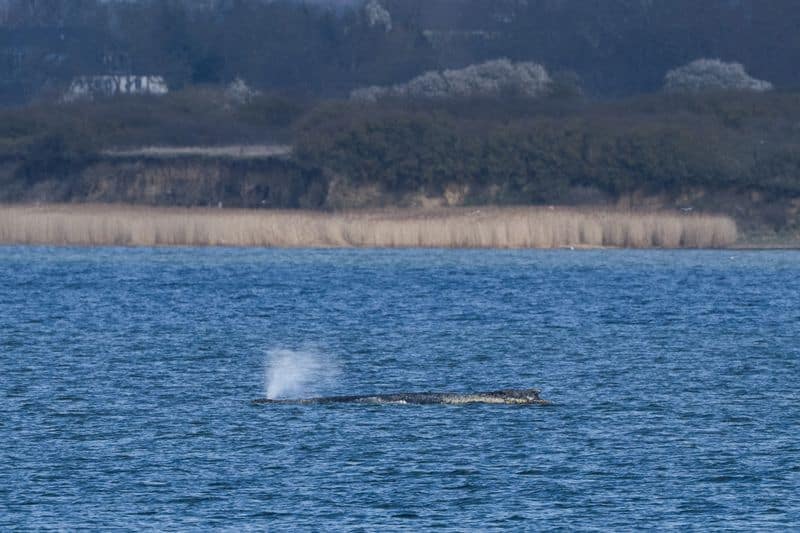
BERLIN, March 29 (Reuters) - A young humpback whale named Timmy by rescuers was struggling to find its way out of shallow bays off the Baltic coast of Germany on Sunday morning, after a week-long ordeal that has put its survival in doubt.
The plight of Timmy, who is thought to measure 12 to 15 metres in length, shows the difficulty of freeing such creatures given their size, with rescuers using dredging equipment and boats to guide the whale back onto a long route to the Atlantic.
After days of efforts to free the animal, rescuers are now hoping the whale will manage to make it out on its own.
“The whale is quite weak. We’re still hopeful that it will pull through,” Daniela von Schaper, a marine expert at Greenpeace, told Reuters.
The whale, whose gender has not been established, was named after Timmendorfer Strand, the white sandy beach on Germany’s resort-filled Baltic coastline where it was first spotted on a nearby sandbank on Monday.
Repeated rescue attempts have failed since, with Greenpeace and its partners documenting an animal in severe stress with skin irritation and fishing gear entangled in its mouth.
There were brief glimmers of hope over the weekend, when the whale managed to free itself twice before running into difficulty again.
Humpback whales are not native to the Baltic Sea. While uncommon, large whales are spotted in the region every couple of years, according to von Schaper.
Conservationists say disrupted migration routes and human influence play a role in whale strandings around the world, though animals can also lose their way while searching for food.
“Some of them find their way out again, others unfortunately do not,” von Schaper said.
(Reporting by Rachel MoreEditing by Ros Russell)