By Angelo Amante
ROME, March 19 (Reuters) - A forthcoming Italian referendum on judicial reform will test right-wing Prime Minister Giorgia Meloni’s political strength and could give the fragmented opposition the impetus to forge a broad alliance ahead of next year’s general election.
Italians will vote on March 22-23 on a proposal to separate the careers of judges and public prosecutors, splitting the self-ruling High Council of the Judiciary (CSM) into two bodies whose members would be chosen by lot rather than elected.
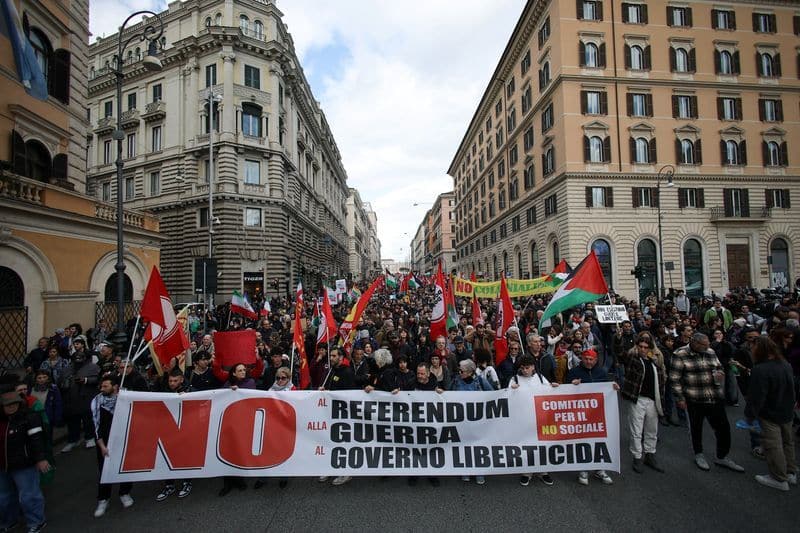
Though centred on the governance of the judiciary, the referendum has become a political showdown between the government-backed ‘Yes’ camp and the opposition, which supports ‘No’. There is no turnout quorum required to validate the vote.
Analysts say most people are likely to cast their ballots based on political preferences, paying little attention to the substance, after a bruising campaign marked by unfounded claims over the potential impact of the reform from both sides.
“Only a small minority of Italians knows much about the issue. Many will look instead to party and coalition leaders, who are all trying to mobilise their voters to win,” said Fabrizio Masia, the head of pollster EMG.
FRESH MOMENTUM TO THE LEFT
Polls published before a two-week pre-ballot blackout took effect showed the two camps neck-and-neck, with opponents of the reform gaining ground amid suggestions that many right-wing supporters may stay home out of apathy.
Meloni has ruled out resigning in the event of defeat, a move widely seen as an attempt to discourage opposition voters from turning out in large numbers in the hope of unseating her.
The coalition — which includes her Brothers of Italy party, the League and Forza Italia — remains more popular than the left, which is still struggling to forge a stable alliance around the Democratic Party and the 5-Star Movement.
“A ‘no’ win could give fresh momentum to efforts to build a centre-left bloc, also causing trouble within Meloni’s ranks,” said pollster Masia.
If the reform passes, however, Meloni would receive a major boost, as she nears the end of her term grappling with the fallout from the broadening U.S.-Israeli war on Iran and a stagnant economy.
“A government victory would strengthen its longer-term political project, also in view of the 2027 election,” said Emanuele Massetti, political science professor at Trento University.
BERLUSCONI’S LEGACY
Justice has been a divisive issue in Italy since former centre-right Prime Minister Silvio Berlusconi faced dozens of trials linked largely to his business empire and often accused judges of political bias.
Massetti said the referendum was the latest chapter in a long-running confrontation between the right and the judiciary, with the issue dividing voters along left-right lines since the era of Berlusconi, who died in 2023.
The campaign has also pitted Meloni against magistrates’ union ANM, which says the reform would weaken judicial independence and increase political interference.
The government rejects that criticism, saying the reform is needed to curb the politicised election of CSM members after scandals exposed backroom deals over senior prosecutor appointments.
“The reform aims to make the justice system more modern, fair, accountable and independent, free from political pressure and from the factionalism that has damaged its credibility and authority,” Meloni told daily Il Dubbio this week.
(Reporting by Angelo Amante, editing by Andrei Khalip)