By Trevor Hunnicutt and David Brunnstrom
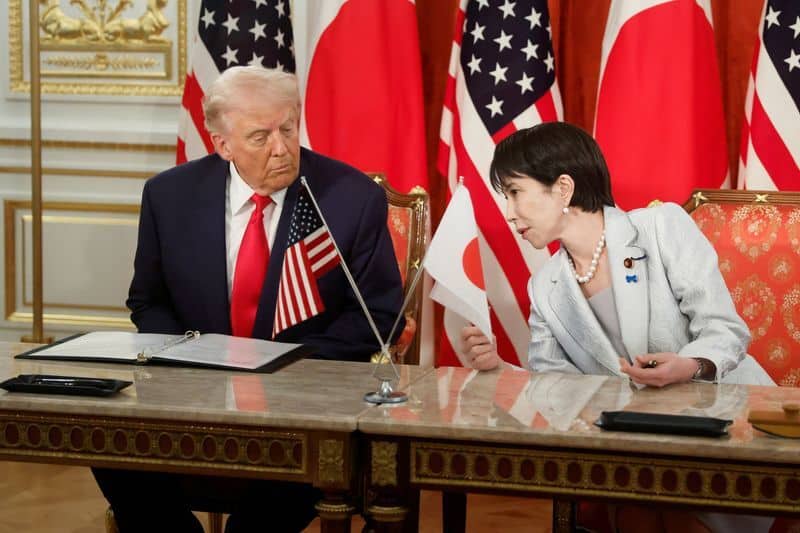
WASHINGTON, March 19 (Reuters) - President Donald Trump may use a White House meeting with Japan’s prime minister on Thursday to press for help in the war on Iran, placing Sanae Takaichi in an awkward position as Tokyo weighs how much support it can provide.
Trump has lashed out at allies for their lukewarm support for the U.S.-Israeli military campaign and said the U.S. doesn’t need any help. However, he is still pushing for more ships to clear mines and escort tankers through the Strait of Hormuz, largely closed by Iran in the conflict.
Trump hosts Takaichi for a long-scheduled White House visit aimed at burnishing the decades-old security and economic partnership between Washington and its closest East Asian ally.
Takaichi has sought to move Japan away from a pacifist constitution imposed by Washington after World War Two, but with the Iran war unpopular at home, she has so far not offered to assist in clearing the Strait of Hormuz.
U.S. allies such as Germany, Italy and Spain have ruled out participating in any Gulf mission, angering Trump.
Takaichi told the Japanese parliament on Monday that Japan had received no official request from the United States but was checking the scope of possible action within the limits of its constitution.
“This has suddenly become a very fraught visit for Takaichi,” said Chris Johnstone, a former White House official who is now a partner at the Asia Group consultancy.
“She was hoping to be effectively the last voice in the room that could influence the president’s approach to his trip to China. Instead, she’s going to be basically the first ally in the room responding to Trump’s request for assistance in the Middle East.”
JAPANESE PREPARE FOR TRUMP ASK ON MISSILES
Trump heaped praise on Takaichi during a visit to Tokyo after she became Japan’s first female prime minister last year. Japanese officials said she hoped to remind him during their meeting of the dangers posed by a regionally assertive China - especially to Taiwan - ahead of his planned visit there.
That trip has now been pushed back from an earlier plan for Trump to visit China in two weeks.
On Wednesday U.S. intelligence agencies created more potential awkwardness for Takaichi when they said that remarks she made last year in support of Taiwan marked a “significant shift” for a Japanese leader.
Takaichi has maintained that her stance, which sent Tokyo’s relations with Beijing into a nosedive, was consistent with Japan’s long-standing policy.
In her meeting with Trump, Takaichi may have to find a way of placating him over his demand for ships while avoiding domestic legal and political pitfalls.
Japan also expects Trump to ask Tokyo to produce or co-develop missiles that could help replace stocks of U.S. munitions depleted by the Iran war and Russia’s war in Ukraine. Tokyo is still considering how to respond to any such request, according to three Japanese government sources.
Unlike Washington, Tokyo has diplomatic relations with Tehran, creating a potential avenue for diplomacy in any moves to end the war, although past attempts by Japan to mediate with Tehran in 2019 were unsuccessful.
Takaichi will also tell Trump that Japan intends to join the “Golden Dome” missile defense initiative that is meant to detect, track and potentially counter incoming threats from orbit, two Japanese government sources said.
Asked how Trump’s demands for help with the war on Iran could figure into the meeting, a White House official declined to say, noting instead the two leaders would discuss implementation of a trade deal the two countries signed in 2025.
“They will also discuss energy, secure supply chains, regional security issues, and bilateral cooperation in science, technology, and defense,” the official said.
Takaichi is expected to announce a fresh wave of Japanese investment in Trump-approved projects in the U.S., from a $550 billion commitment made by the government to win relief from tariffs the U.S. president imposed last year.
Japan could pledge some $60 billion as part of the second tranche of its investments spanning critical minerals and energy, according to a person familiar with plans for the meeting, after already committing to three projects valued at $36 billion.
(Reporting by Trevor Hunnicutt and David Brunnstrom; Additional reporting by Tamiyuki Kihara, Tim Kelly and John Geddie in Tokyo and Michael Martina in Washington, editing by Ross Colvin and Deepa Babington)